Updated August 2026 · Our team visited in person
Chengdu Panda Base: The Complete 2026 Visitor's Guide
The Chengdu Research Base of Giant Panda Breeding is home to over 200 giant pandas — the highest concentration on Earth. Here's everything you need to plan a perfect visit: ticket strategy, the step-by-step route that beats the crowds, baby panda season timing, and the honest comparison between Chengdu and Dujiangyan bases.
At a glance
CNY 55 (adults) · Free for kids under 6 · Online booking recommended
7:30 AM – 6:00 PM daily · Ticket sales stop at 5:00 PM
Line 3 to Panda Avenue Station (熊猫大道) · Exit A for shuttle bus
March – May and September – November · Arrive by 8:00 AM
3–4 hours minimum · Half-day recommended
Nursery open year-round · Cubs visible July – October
The step-by-step route — how to see everything before the crowds
This route follows the order that maximizes active panda sightings. Start at the nursery first thing, work downhill through the enclosures, and finish at the quieter areas most tour groups skip.
Moonlight Nursery (月亮产房)
30–45 minStart here the moment the gates open. This is where the youngest cubs live — tiny, pink newborns in incubators (July–Sept) and slightly older cubs tumbling around their play enclosure. Get here first because the queue builds fast and you want the glass-front view for photos. The cubs are most active from 8:00–9:30 AM. After 10:30 they're usually asleep.
Sub-Adult Enclosure (幼年大熊猫别墅)
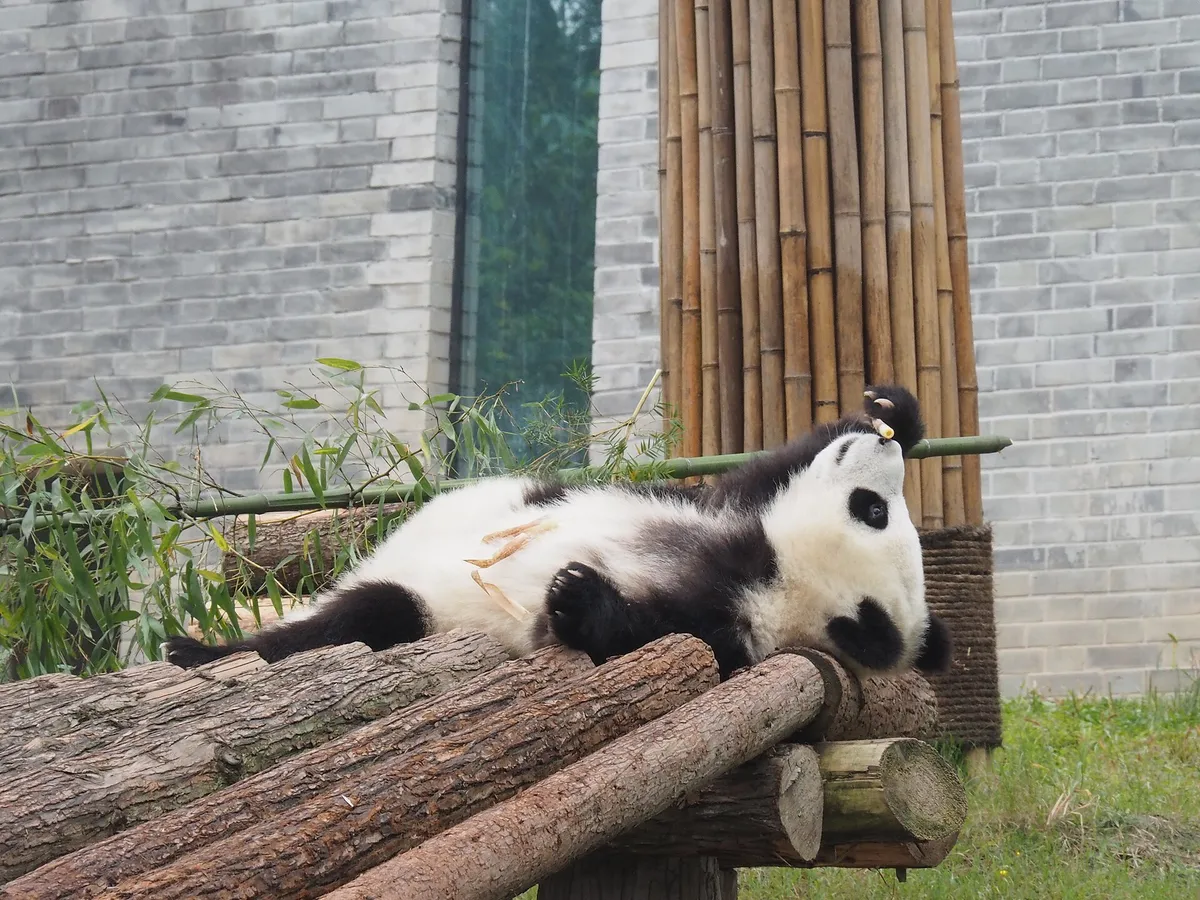
30–40 minA 5-minute walk from the nursery. This is where the action is. Pandas aged 1–3 years climb trees, wrestle each other, slide down wooden platforms, and generally act like oversized toddlers. The best photo opportunities on the entire base. There are usually 4–6 pandas in this area at any time. Find a spot along the railing and wait — the pandas move between climbing structures and the bamboo feeding stations.
Adult Panda Villas (大熊猫别墅)
20–30 minSeveral villas spread across the park, numbered 1 through 14. Each houses 1–3 adult pandas. The adults are less active than the youngsters but watching a full-grown panda methodically strip and eat bamboo — sitting upright like a person — is oddly hypnotic. Villa 1 and Villa 2 are closest to the main path and most crowded. Walk further to Villa 7–9 for fewer people and better viewing angles.
Red Panda Area + Swan Lake
20–30 minOften overlooked but genuinely delightful. Red pandas (actually unrelated to giant pandas, more like raccoons) are active, curious, and sometimes walk across the path right in front of you. The nearby swan lake with its black swans and willow trees is a quiet, photogenic spot most tourists skip. Good place to rest and review your photos.
Panda Museum & Gift Shop
15–20 minA small museum near the exit with panda evolution displays, conservation history, and a decent gift shop. The stuffed pandas here are higher quality than the street vendors outside. Worth 15 minutes before you leave.
Chengdu Panda Base vs Dujiangyan Panda Base
Two bases, two very different experiences. Use this comparison to decide which one fits your trip.
| Chengdu Research Base | Dujiangyan Panda Base | |
|---|---|---|
| Pandas | ~200 giant pandas across multiple enclosures | ~20 pandas in open-air hillside enclosures |
| Baby pandas | Nursery with cubs year-round · peak July–Oct | Limited cub viewing · seasonal only |
| Distance from city | 30 min by Metro from Chunxi Road | 1.5 h by car or train · needs day trip planning |
| Crowds | Very crowded by 10 AM · weekdays better | Quiet even on weekends · far fewer tourists |
| Volunteer program | Not available to visitors | Hands-on keeper program · 700–1,000 RMB · book weeks ahead |
| Photo quality | Good but often through glass · zoom lens helpful | Excellent · open-air enclosures · no glass barriers |
| Best for | First-timers · families with kids · short on time | Photographers · volunteers · combining with Qingcheng Mountain |
| Combined with | City attractions · same-day visit | Dujiangyan Irrigation System (UNESCO) · Mount Qingcheng (Taoist mountain) |
Pick Chengdu if…
- → You want to see as many pandas as possible (~200)
- → Seeing baby pandas in the nursery is a priority
- → You're short on time (30 min Metro from downtown)
- → You're visiting with young children
Pick Dujiangyan if…
- → You want the hands-on volunteer keeper program
- → You prefer a quiet, uncrowded hillside experience
- → You're combining with Mount Qingcheng or the Irrigation System
- → Open-air enclosures for clearer photos (no glass)
5 mistakes first-timers make at the Panda Base
Everyone makes at least one of these. Learn from the people who went before you.
Arriving at 10 AM or later
By 10 AM pandas are settling in for their mid-morning nap. By 11 AM most are fully asleep. Arrive at 7:45 AM to be among the first through the gates at 8:00. You'll get 2–3 hours of active pandas before they crash.
Going on a weekend or Chinese holiday
Weekends and holidays (especially Golden Week in October and Spring Festival) are extremely crowded. Lines for the nursery can exceed 30 minutes. If you must go on a weekend, arrive at 7:30 AM — even 7:00 AM for holidays. Weekdays (Tuesday–Thursday) are dramatically quieter.
Not bringing enough camera battery
You will take more photos than you expect. A single panda eating bamboo can fill a 64GB card. Bring a spare battery or power bank — there are no charging stations in the park.
Skipping the shuttle bus
The base covers 100 hectares. The shuttle bus (CNY 10, hop-on hop-off) saves 20–30 minutes of uphill walking between the entrance and the far enclosures. Take it to the nursery first thing, then walk back downhill through the other areas.
Not checking the weather
Pandas hate heat. On days above 30°C (86°F), they're moved to air-conditioned indoor enclosures. You'll still see them, but through glass. Cooler mornings (March–May, September–November) mean outdoor viewing. Check the forecast and plan accordingly.
Frequently asked questions
Ready to see the pandas?
Book your tickets online before you go — morning slots sell out fast on weekends and holidays.